May 22
Sunday
5th Sunday of Easter
►1st Reading: Acts 6:1–7
In those days, as the number of disciples grew, the so-called Hellenists complained against the so-called Hebrews, because their widows were being neglected in the daily distribution. So the Twelve summoned the whole body of disciples together and said, “It is not right that we should neglect the word of God to serve at tables. So, friends, choose from among yourselves seven respected men full of Spirit and wisdom, that we may appoint them to this task. As for us, we shall give ourselves to prayer and to the ministry of the Word.”
The whole community agreed and they chose Stephen, a man full of faith and Holy Spirit; Philip, Prochorus, Nicanor, Timon, Parmenus and Nicolaus of Antioch who was a proselyte. They presented these men to the apostles who first prayed over them and then laid hands upon them.
The Word of God continued to spread, and the number of the disciples in Jerusalem increased greatly and even many priests accepted the faith.
►Ps 33:1–2, 4–5, 18–19
Lord, let your mercy be on us, as we place our trust in you.
►2nd Reading: 1 P 2:4–9
Dear sisters and brothers, Jesus is the living stone rejected by people but chosen by God and precious to him. On drawing close to him, you also became living stones built into a spiritual temple, a holy community of priests offering spiritual sacrifices which please God through Jesus Christ. Scripture says: See, I lay in Zion a chosen and precious cornerstone; whoever believes in him will not be disappointed.
This means honor for you who believed, but for unbelievers also the stone which the builders rejected has become the cornerstone and it is a stone to stumble over, a rock which lays people low. They stumble over it in rejecting the Word, but the plan of God is fulfilled in this.
You are a chosen race, a community of priest-kings, a consecrated nation, a people God has made his own to proclaim his wonders. For he called you from your darkness to his own wonderful light.
►Gospel: Jn 14:1–12
Jesus said to his disciples, “Do not be troubled; trust in God and trust in me. In my Father’s house there are many rooms. Otherwise I would not have told you that I go to prepare a place for you. After I have gone and prepared a place for you, I shall come again and take you to me, so that where I am, you also may be. Yet you know the way where I am going.”
Thomas said to him, “Lord, we don’t know where you are going; how can we know the way?” Jesus said, “I am the way, the truth and the life; no one comes to the Father but through me. If you know me, you will know the Father also; indeed you know him and you have seen him.”
Philip asked him, “Lord, show us the Father and that is enough.” Jesus said to him, “What! I have been with you so long and you still do not know me, Philip? Whoever sees me sees the Father; how can you say: ‘Show us the Father’? Do you not believe that I am in the Father and the Father is in me?
“All that I say to you, I do not say of myself. The Father who dwells in me is doing his own work. Believe me when I say that I am in the Father and the Father is in me; at least believe it on the evidence of these works that I do.
“Truly, I say to you, the one who believes in me will do the same works that I do; and he will even do greater than these, for I am going to the Father.”
Showing posts with label sunday readings. Show all posts
Friday, May 20, 2011
Friday, April 15, 2011
Holy Thursday! (Holy Week)
April 21
Thursday
►1st Reading: Ex 12:1–8, 11–14
Yahweh spoke to Moses and Aaron in the land of Egypt and said, “This month is to be the beginning of all months, the first month of your year. Speak to the community of Israel and say to them:
On the tenth day of this month let each family take a lamb, a lamb for each house. If the family is too small for a lamb, they must join with a neighbor, the nearest to the house, according to the number of persons and to what each one can eat.
You will select a perfect lamb without blemish, a male born during the present year, taken from the sheep or goats. Then you will keep it until the fourteenth day of the month.
On that evening all the people will slaughter their lambs and take some of the blood to put on the doorposts and on top of the doorframes of the houses where you eat.
That night you will eat the flesh roasted at the fire with unleavened bread and bitter herbs.
And this is how you will eat: with a belt round your waist, sandals on your feet and a staff in your hand. You shall eat hastily for it is a passover in honor of Yahweh. On that night I shall go through Egypt and strike every firstborn in Egypt, men and animals; and I will even bring judgment on all the gods of Egypt, I, Yahweh! The blood on your houses will be the sign that you are there. I will see the blood and pass over you; and you will es-cape the mortal plague when I strike Egypt.
This is a day you are to remember and celebrate in honor of Yah-weh. It is to be kept as a festival day for all generations forever.
►Ps 116:12–13, 15–16bc, 17–18
Our blessing-cup is a communion with the Blood of Christ.
►2nd Reading: 1 Cor 11:23–26
Brothers and sisters: This is the tradition of the Lord that I received and that in my turn I have handed on to you; the Lord Jesus, on the night that he was delivered up, took bread and, after giving thanks, broke it, saying, “This is my body which is broken for you; do this in memory of me.” In the same manner, taking the cup after the supper, he said, “This cup is the new Covenant in my blood. Whenever you drink it, do it in memory of me.” So, then, whenever you eat of this bread and drink from this cup, you are proclaiming the death of the Lord until he comes.
►Gospel: Jn 13:1–15
It was before the feast of the Passover. Jesus realized that his hour had come to pass from this world to the Father, and as he had loved those who were his own in the world, he would love them with perfect love.
They were at supper and the devil had already put into the mind of Judas, son of Simon Iscariot, to betray. Jesus knew that the Father had entrusted all things to him, and as he had come from God, he was going to God. So he got up from table, removed his garment and taking a towel, wrapped it around his waist. Then he poured water into a basin and began to wash the disciples’ feet and to wipe them with the towel he was wearing.
When he came to Simon Peter, Simon said to him, “Why, Lord, you want to wash my feet!” Jesus said, “What I am doing you cannot understand now, but afterwards you will understand it.” Peter replied, “You shall never wash my feet.”
Jesus answered him, “If I do not wash you, you can have no part with me.” Then Simon Peter said, “Lord, wash not only my feet, but also my hands and my head!”
Jesus replied, “Whoever has taken a bath does not need to wash (except the feet), for he is clean all over. You are clean, though not all of you.” Jesus knew who was to betray him; because of this he said, “Not all of you are clean.”
When Jesus had finished washing their feet, he put on his garment again, went back to the table and said to them, “Do you understand what I have done to you? You call me Master and Lord, and you are right, for so I am. If I, then, your Lord and Master, have washed your feet, you also must wash one another’s feet. I have just given you an example that as I have done, you also may do.”
Thursday
►1st Reading: Ex 12:1–8, 11–14
Yahweh spoke to Moses and Aaron in the land of Egypt and said, “This month is to be the beginning of all months, the first month of your year. Speak to the community of Israel and say to them:
On the tenth day of this month let each family take a lamb, a lamb for each house. If the family is too small for a lamb, they must join with a neighbor, the nearest to the house, according to the number of persons and to what each one can eat.
You will select a perfect lamb without blemish, a male born during the present year, taken from the sheep or goats. Then you will keep it until the fourteenth day of the month.
On that evening all the people will slaughter their lambs and take some of the blood to put on the doorposts and on top of the doorframes of the houses where you eat.
That night you will eat the flesh roasted at the fire with unleavened bread and bitter herbs.
And this is how you will eat: with a belt round your waist, sandals on your feet and a staff in your hand. You shall eat hastily for it is a passover in honor of Yahweh. On that night I shall go through Egypt and strike every firstborn in Egypt, men and animals; and I will even bring judgment on all the gods of Egypt, I, Yahweh! The blood on your houses will be the sign that you are there. I will see the blood and pass over you; and you will es-cape the mortal plague when I strike Egypt.
This is a day you are to remember and celebrate in honor of Yah-weh. It is to be kept as a festival day for all generations forever.
►Ps 116:12–13, 15–16bc, 17–18
Our blessing-cup is a communion with the Blood of Christ.
►2nd Reading: 1 Cor 11:23–26
Brothers and sisters: This is the tradition of the Lord that I received and that in my turn I have handed on to you; the Lord Jesus, on the night that he was delivered up, took bread and, after giving thanks, broke it, saying, “This is my body which is broken for you; do this in memory of me.” In the same manner, taking the cup after the supper, he said, “This cup is the new Covenant in my blood. Whenever you drink it, do it in memory of me.” So, then, whenever you eat of this bread and drink from this cup, you are proclaiming the death of the Lord until he comes.
►Gospel: Jn 13:1–15
It was before the feast of the Passover. Jesus realized that his hour had come to pass from this world to the Father, and as he had loved those who were his own in the world, he would love them with perfect love.
They were at supper and the devil had already put into the mind of Judas, son of Simon Iscariot, to betray. Jesus knew that the Father had entrusted all things to him, and as he had come from God, he was going to God. So he got up from table, removed his garment and taking a towel, wrapped it around his waist. Then he poured water into a basin and began to wash the disciples’ feet and to wipe them with the towel he was wearing.
When he came to Simon Peter, Simon said to him, “Why, Lord, you want to wash my feet!” Jesus said, “What I am doing you cannot understand now, but afterwards you will understand it.” Peter replied, “You shall never wash my feet.”
Jesus answered him, “If I do not wash you, you can have no part with me.” Then Simon Peter said, “Lord, wash not only my feet, but also my hands and my head!”
Jesus replied, “Whoever has taken a bath does not need to wash (except the feet), for he is clean all over. You are clean, though not all of you.” Jesus knew who was to betray him; because of this he said, “Not all of you are clean.”
When Jesus had finished washing their feet, he put on his garment again, went back to the table and said to them, “Do you understand what I have done to you? You call me Master and Lord, and you are right, for so I am. If I, then, your Lord and Master, have washed your feet, you also must wash one another’s feet. I have just given you an example that as I have done, you also may do.”
Thursday, April 14, 2011
Passion (Palm) Sunday
April 17
Sunday
►1st Reading: Is 50:4–7
The Lord Yahweh has taught me so I speak as his disciple and I know how to sustain the weary. Morning after morning he wakes me up to hear, to listen like a disciple. The Lord Yahweh has opened my ear. I have not rebelled, nor have I withdrawn. I offered my back to those who strike me, my cheeks to those who pulled my beard; neither did I shield my face from blows, spittle and disgrace. I have not despaired, for the Lord Yahweh comes to my help. So, like a flint I set my face, knowing that I will not be disgraced.
►Ps 22:8–9, 17–18, 19–20, 23–24
My God, my God, why have you abandoned me?
►2nd Reading: Phil 2:6–11
Though being divine in nature, Christ Jesus did not claim in fact equality with God, but emptied himself, taking on the nature of a servant, made in human likeness, and in his appearance found as a man. He humbled himself by being obedient to death, death on the cross. That is why God exalted him and gave him the Name which outshines all names, so that at the Name of Jesus all knees should bend in heaven, on earth and among the dead, and all tongues proclaim that Christ Jesus is the Lord to the glory of God the Father.
►Gospel: Mt 26:14—27:66 (or Mt 27:11–54)
Then one of the Twelve, who was called Judas Iscariot, went to the chief priests and said, “How much will you give me if I hand him over to you?” They promised to give him thirty pieces of silver, and from then on, he kept looking for the best way to hand Jesus over to them.
On the first day of the Festival of Unleavened Bread, the disciples came to Jesus and said to him, “Where do you want us to prepare the Passover meal for you?” Jesus answered, “Go into the city, to the house of a certain man, and tell him, ‘The Master says: My hour is near, and I will celebrate the Passover with my disciples in your house.’”
The disciples did as Jesus had ordered, and prepared the Passover meal.
When it was evening, Jesus sat at table with the Twelve. While they were eating, Jesus said, “Truly I say to you: one of you will betray me.” They were deeply distressed, and they asked him, one after the other, “You do not mean me, do you, Lord?”
He answered, “He who will betray me is one of those who dips his bread in the dish with me. The Son of Man is going as the Scriptures say he will. But alas for that one who betrays the Son of Man: better for him not to have been born.” Judas, who was betraying him, also asked, “You do not mean me, Master, do you?” Jesus replied, “You have said it.”
While they were eating, Jesus took bread, said a blessing and broke it, and gave it to his disciples saying, “Take and eat: this is my body.” Then he took a cup, and gave thanks, and passed it to them, saying, “Drink this, all of you, for this is my blood, the blood of the Covenant, which is poured out for many for the forgiveness of sins. Yes, I say to you: From now on I will not taste the fruit of the vine, until that day when I drink new wine with you in my Father’s kingdom.”
After singing psalms of praise, they went out to the Mount of Olives. Then Jesus said to them, “You will falter tonight because of me, and all will fall. For the Scripture says: I will strike the shepherd and the sheep will be scattered. But after my resurrection, I will go ahead of you to Galilee.”
Peter responded, “Even though all doubt you and fall, I will never fall.” Jesus replied, “Truly I say to you: this very night before the cock crows, you will deny me three times.” Peter said, “Though I have to die with you, I will never deny you.” And all the disciples said the same.
Jesus came with them to a place called Gethsemane, and he said to his disciples, “Sit here while I go over there to pray.”
He took Peter and the two sons of Zebedee with him, and he began to be filled with anguish and distress. And he said to them, “My soul is full of sorrow, even to death. Remain here and stay awake with me.”
He went a little farther and fell to the ground, with his face touching the earth, and prayed, “Father, if it is possible, take this cup away from me. Yet not what I want, but what you want.” He went back to his disciples and found them asleep, and he said to Peter, “Could you not stay awake with me for even an hour? Stay awake and pray, so that you may not slip into temptation. The spirit indeed is eager, but the body is weak.”
He again went away, and prayed, “Father, if this cup cannot be taken away from me without my drinking it, let your will be done.” When he came back to his disciples, he again found them asleep, for they could not keep their eyes open. He left them again, and went to pray the third time, saying the same words.
Then he came back to his disciples and said to them, “You can sleep on now and take your rest! The hour has come, and the Son of Man will be handed over to sinners. Get up, let us go. Look: the betrayer is here!”
Jesus was still speaking when Judas, one of the Twelve, arrived. With him was a crowd armed with swords and clubs, who had been sent by the chief priests and the Jewish authorities. The traitor had arranged a signal for them: “The one I kiss, he is the man; arrest him.” Judas went directly to Jesus and said, “Good evening, Master”; and he gave him a kiss. But Jesus said to him, “Friend, do what you came for.” Then they laid hands on Jesus, and arrested him.
One of those who were with Jesus drew his sword, and struck at the servant of the High Priest, cutting off his ear. So Jesus said to him, “Put your sword back into its place, for he who uses the sword will perish by the sword. Do you not know that I could call on my Father, and he would at once send me more than twelve legions of angels. If Scripture says that this has to be, should it not be fulfilled?”
At that moment, Jesus said to the crowd, “Why do you come to arrest me with swords and clubs, as if I were a robber? Day after day I was seated among you teaching in the Temple, yet you did not arrest me. But all this has come about in fulfillment of what the Prophets said.” Then all his disciples deserted him and fled.
Those who had arrested Jesus brought him to the house of the High Priest Caiaphas, where the teachers of the Law and the elders were assembled.
Peter followed Jesus at a distance, as far as the courtyard of the High Priest; he entered and sat with the guards, waiting to see the end.
The chief priests and the whole Supreme Council needed some false evidence against Jesus, so that they might put him to death. But they were unable to find any, even though false witnesses came forward. At last, two men came up and declared, “This man said, ‘I am able to destroy the temple of God and rebuild it in three days.’”
The High Priest then stood up and asked Jesus, “Have you no answer at all? What is this evidence against you?” But Jesus kept silent.
So the High Priest said to him, “In the name of the living God, I command you to tell us: Are you the Messiah, the Son of God?” Jesus answered, “It is just as you say. I tell you more: from now on, you will see the Son of Man, seated at the right hand of God most powerful, and coming on the clouds of heaven.”
Then the High Priest tore his clothes, saying, “He has blasphemed. What more evidence do we need? You have just heard these blasphemous words. What is your decision?” They answered, “He must die!” Then they began to spit on Jesus and slap him, while others hit him with their fists, saying, “Messiah, prophesy! Who hit you?”
Meanwhile, as Peter sat outside in the courtyard, a young servant-girl of the house said to him, “You also were with Jesus of Galilee.” But he denied it before everyone, saying, “I do not know what you are talking about.”
And as Peter was going out to the gateway, another servant-girl saw him and told the bystanders, “This man was with Jesus of Nazareth.”
Peter denied it again with an oath, swearing, “I do not know that man.”
After a little while, those who were standing there approached Peter and said to him, “Of course you are one of the Galileans: your accent gives you away.” Peter began justifying himself with curses and oaths, protesting that he did not know Jesus. Just then a cock crowed.
And Peter remembered the words of Jesus, “Before the cock crows, you will deny me three times.” And he went away weeping bitterly.
Early in the morning, all the chief priests and the elders of the people met together to look for ways of putting Jesus to death. They had him bound, and led him away to be handed over to Pilate, the governor.
When Judas, the traitor, realized that Jesus had been condemned, he was filled with remorse, and returned the thirty pieces of silver to the chief priests and the elders, saying, “I have sinned by betraying an innocent man to death.” They answered, “What does it matter to us? That is your concern.” So throwing down the money in the Temple, he went away and hanged himself.
The priests picked up the money and said, “This money cannot be put into the Temple treasury, for this is the price of blood.” So they met together, and decided to buy the Potter’s Field with the money, and to make it a cemetery for foreigners. That is why, to this day, that place has been called Field of Blood.
So what the prophet Jeremiah said was fulfilled: They took the thirty pieces of silver, the price which the Sons of Israel set on him, and they gave them for the Potter’s Field, as the Lord commanded me.
Jesus stood before the governor, who asked him, “Are you the King of the Jews?” Jesus answered, “You say so.”
The chief priests and the elders of the people accused him, but he made no answer. Pilate said to him, “Do you hear all the charges they bring against you?” But he did not answer even a single question, so that the governor wondered greatly.
At Passover, it was customary for the governor to release any prisoner the people asked for. Now there was a well-known prisoner called Barabbas. 17 When the people had gathered, Pilate asked them, “Whom do you want me to set free: Barabbas, or Jesus called the Messiah?” for he realized that Jesus had been handed over to him out of envy.
As Pilate was sitting in court, his wife sent him this message, “Have nothing to do with that holy man. Because of him, I had a dream last night that disturbed me greatly.”
But the chief priests and the elders of the people stirred up the crowds, to ask for the release of Barabbas and the death of Jesus. When the governor asked them again, “Which of the two do you want me to set free?” they answered, “Barabbas!” Pilate said to them, “And what shall I do with Jesus called the Messiah?” All answered, “Crucify him!” Pilate insisted, “What evil has he done?” But they shouted louder, “Crucify him!”
Pilate realized that he was getting nowhere, and that there could be a riot. He then asked for water, and washed his hands before the people, saying, “I am not responsible for his blood. It is your doing.” And all the people answered, “Let his blood be upon us and upon our children.”
Then Pilate set Barabbas free, but had Jesus scourged, and handed him over to be crucified.
The Roman soldiers took Jesus into the palace of the governor and the whole troop gathered around him. They stripped him and dressed him in a purple military cloak. Then, twisting a crown of thorns, they forced it onto his head, and placed a reed in his right hand. They knelt before Jesus and mocked him, saying, “Long life to the King of the Jews!” They spat on him, took the reed from his hand and struck him on the head with it.
When they had finished mocking him, they pulled off the purple cloak and dressed him in his own clothes again, and led him out to be crucified.
Continue here perlie
On the way they met a man from Cyrene called Simon, and forced him to carry the cross of Jesus. When they reached the place called Golgotha, which means the Skull, 34 they offered him wine mixed with gall. Jesus tasted it but would not drink it.
There they crucified him, and divided his clothes among themselves, casting lots to decide what each one should take. Then they sat down to guard him. The statement of his offense was displayed above his head, and it read, “This is Jesus, the King of the Jews.” They also crucified two bandits with him, one on his right hand and one on his left.
People passing by shook their heads and insulted him, saying, “Aha! You who destroy the Temple and in three days rebuild it, save yourself—if you are God’s Son—and come down from the cross!”
In the same way the chief priests, the elders and the teachers of the Law mocked him. They said, “The man who saved others cannot save himself. Let the King of Israel now come down from his cross and we will believe in him. He trusted in God; let God rescue him if God wants to, for he himself said, ‘I am the Son of God.’”
Even the robbers who were crucified with him insulted him.
From midday, darkness fell over the whole land until mid-afternoon. At about three o’clock, Jesus cried out in a loud voice, “Eloi, Eloi, lamma sabbacthani?” which means: My God, my God, why have you forsaken me? As soon as they heard this, some of the bystanders said, “He is calling for Elijah.” And one of them ran, took a sponge and soaked it in vinegar and, putting it on a reed, gave him to drink. Others said, “Leave him alone, let us see whether Elijah comes to his rescue.”
Then Jesus cried out again in a loud voice and gave up his spirit.
Just then the curtain of the Temple sanctuary was torn in two from top to bottom, the earth quaked, rocks were split, tombs were opened, and many holy people who had died were raised to life. They came out of the tombs after the resurrection of Jesus, entered the Holy City, and appeared to many.
The captain and the soldiers who guarded Jesus were greatly terrified, when they saw the earthquake and all that had happened, and said, “Truly, this was God’s Son.”
There were also some women there, who watched from a distance; they had followed Jesus from Galilee and had seen to his needs. Among them were Mary Magdalene, Mary the mother of James and Joseph, and the mother of Zebedee’s sons.
It was now evening, and there came a wealthy man from Arimathea, named Joseph, who was also a disciple of Jesus. He went to Pilate and asked for the body of Jesus, and the governor ordered that the body be given to him. So Joseph took the body of Jesus, wrapped it in a clean linen sheet, and laid it in his own new tomb, which had been cut out of the rock. Then he rolled a huge stone across the entrance to the tomb and left. Mary Magdalene and the other Mary remained sitting there in front of the tomb.
On the following day, the day after the Preparation for the Sabbath observance, the chief priests and the Pharisees went to Pilate and said to him, “Sir, we remember that when that impostor was still alive, he said, ‘I will rise after three days.’ Therefore, have his tomb secured until the third day, lest his disciples come and steal the body, and say to the people: He is risen from the dead. This would be a worse lie than the first.” Pilate answered them, “You have soldiers, go and take all the necessary precautions.” So they went to the tomb and secured it, sealing the stone, and placed it under guard.
Sunday
►1st Reading: Is 50:4–7
The Lord Yahweh has taught me so I speak as his disciple and I know how to sustain the weary. Morning after morning he wakes me up to hear, to listen like a disciple. The Lord Yahweh has opened my ear. I have not rebelled, nor have I withdrawn. I offered my back to those who strike me, my cheeks to those who pulled my beard; neither did I shield my face from blows, spittle and disgrace. I have not despaired, for the Lord Yahweh comes to my help. So, like a flint I set my face, knowing that I will not be disgraced.
►Ps 22:8–9, 17–18, 19–20, 23–24
My God, my God, why have you abandoned me?
►2nd Reading: Phil 2:6–11
Though being divine in nature, Christ Jesus did not claim in fact equality with God, but emptied himself, taking on the nature of a servant, made in human likeness, and in his appearance found as a man. He humbled himself by being obedient to death, death on the cross. That is why God exalted him and gave him the Name which outshines all names, so that at the Name of Jesus all knees should bend in heaven, on earth and among the dead, and all tongues proclaim that Christ Jesus is the Lord to the glory of God the Father.
►Gospel: Mt 26:14—27:66 (or Mt 27:11–54)
Then one of the Twelve, who was called Judas Iscariot, went to the chief priests and said, “How much will you give me if I hand him over to you?” They promised to give him thirty pieces of silver, and from then on, he kept looking for the best way to hand Jesus over to them.
On the first day of the Festival of Unleavened Bread, the disciples came to Jesus and said to him, “Where do you want us to prepare the Passover meal for you?” Jesus answered, “Go into the city, to the house of a certain man, and tell him, ‘The Master says: My hour is near, and I will celebrate the Passover with my disciples in your house.’”
The disciples did as Jesus had ordered, and prepared the Passover meal.
When it was evening, Jesus sat at table with the Twelve. While they were eating, Jesus said, “Truly I say to you: one of you will betray me.” They were deeply distressed, and they asked him, one after the other, “You do not mean me, do you, Lord?”
He answered, “He who will betray me is one of those who dips his bread in the dish with me. The Son of Man is going as the Scriptures say he will. But alas for that one who betrays the Son of Man: better for him not to have been born.” Judas, who was betraying him, also asked, “You do not mean me, Master, do you?” Jesus replied, “You have said it.”
While they were eating, Jesus took bread, said a blessing and broke it, and gave it to his disciples saying, “Take and eat: this is my body.” Then he took a cup, and gave thanks, and passed it to them, saying, “Drink this, all of you, for this is my blood, the blood of the Covenant, which is poured out for many for the forgiveness of sins. Yes, I say to you: From now on I will not taste the fruit of the vine, until that day when I drink new wine with you in my Father’s kingdom.”
After singing psalms of praise, they went out to the Mount of Olives. Then Jesus said to them, “You will falter tonight because of me, and all will fall. For the Scripture says: I will strike the shepherd and the sheep will be scattered. But after my resurrection, I will go ahead of you to Galilee.”
Peter responded, “Even though all doubt you and fall, I will never fall.” Jesus replied, “Truly I say to you: this very night before the cock crows, you will deny me three times.” Peter said, “Though I have to die with you, I will never deny you.” And all the disciples said the same.
Jesus came with them to a place called Gethsemane, and he said to his disciples, “Sit here while I go over there to pray.”
He took Peter and the two sons of Zebedee with him, and he began to be filled with anguish and distress. And he said to them, “My soul is full of sorrow, even to death. Remain here and stay awake with me.”
He went a little farther and fell to the ground, with his face touching the earth, and prayed, “Father, if it is possible, take this cup away from me. Yet not what I want, but what you want.” He went back to his disciples and found them asleep, and he said to Peter, “Could you not stay awake with me for even an hour? Stay awake and pray, so that you may not slip into temptation. The spirit indeed is eager, but the body is weak.”
He again went away, and prayed, “Father, if this cup cannot be taken away from me without my drinking it, let your will be done.” When he came back to his disciples, he again found them asleep, for they could not keep their eyes open. He left them again, and went to pray the third time, saying the same words.
Then he came back to his disciples and said to them, “You can sleep on now and take your rest! The hour has come, and the Son of Man will be handed over to sinners. Get up, let us go. Look: the betrayer is here!”
Jesus was still speaking when Judas, one of the Twelve, arrived. With him was a crowd armed with swords and clubs, who had been sent by the chief priests and the Jewish authorities. The traitor had arranged a signal for them: “The one I kiss, he is the man; arrest him.” Judas went directly to Jesus and said, “Good evening, Master”; and he gave him a kiss. But Jesus said to him, “Friend, do what you came for.” Then they laid hands on Jesus, and arrested him.
One of those who were with Jesus drew his sword, and struck at the servant of the High Priest, cutting off his ear. So Jesus said to him, “Put your sword back into its place, for he who uses the sword will perish by the sword. Do you not know that I could call on my Father, and he would at once send me more than twelve legions of angels. If Scripture says that this has to be, should it not be fulfilled?”
At that moment, Jesus said to the crowd, “Why do you come to arrest me with swords and clubs, as if I were a robber? Day after day I was seated among you teaching in the Temple, yet you did not arrest me. But all this has come about in fulfillment of what the Prophets said.” Then all his disciples deserted him and fled.
Those who had arrested Jesus brought him to the house of the High Priest Caiaphas, where the teachers of the Law and the elders were assembled.
Peter followed Jesus at a distance, as far as the courtyard of the High Priest; he entered and sat with the guards, waiting to see the end.
The chief priests and the whole Supreme Council needed some false evidence against Jesus, so that they might put him to death. But they were unable to find any, even though false witnesses came forward. At last, two men came up and declared, “This man said, ‘I am able to destroy the temple of God and rebuild it in three days.’”
The High Priest then stood up and asked Jesus, “Have you no answer at all? What is this evidence against you?” But Jesus kept silent.
So the High Priest said to him, “In the name of the living God, I command you to tell us: Are you the Messiah, the Son of God?” Jesus answered, “It is just as you say. I tell you more: from now on, you will see the Son of Man, seated at the right hand of God most powerful, and coming on the clouds of heaven.”
Then the High Priest tore his clothes, saying, “He has blasphemed. What more evidence do we need? You have just heard these blasphemous words. What is your decision?” They answered, “He must die!” Then they began to spit on Jesus and slap him, while others hit him with their fists, saying, “Messiah, prophesy! Who hit you?”
Meanwhile, as Peter sat outside in the courtyard, a young servant-girl of the house said to him, “You also were with Jesus of Galilee.” But he denied it before everyone, saying, “I do not know what you are talking about.”
And as Peter was going out to the gateway, another servant-girl saw him and told the bystanders, “This man was with Jesus of Nazareth.”
Peter denied it again with an oath, swearing, “I do not know that man.”
After a little while, those who were standing there approached Peter and said to him, “Of course you are one of the Galileans: your accent gives you away.” Peter began justifying himself with curses and oaths, protesting that he did not know Jesus. Just then a cock crowed.
And Peter remembered the words of Jesus, “Before the cock crows, you will deny me three times.” And he went away weeping bitterly.
Early in the morning, all the chief priests and the elders of the people met together to look for ways of putting Jesus to death. They had him bound, and led him away to be handed over to Pilate, the governor.
When Judas, the traitor, realized that Jesus had been condemned, he was filled with remorse, and returned the thirty pieces of silver to the chief priests and the elders, saying, “I have sinned by betraying an innocent man to death.” They answered, “What does it matter to us? That is your concern.” So throwing down the money in the Temple, he went away and hanged himself.
The priests picked up the money and said, “This money cannot be put into the Temple treasury, for this is the price of blood.” So they met together, and decided to buy the Potter’s Field with the money, and to make it a cemetery for foreigners. That is why, to this day, that place has been called Field of Blood.
So what the prophet Jeremiah said was fulfilled: They took the thirty pieces of silver, the price which the Sons of Israel set on him, and they gave them for the Potter’s Field, as the Lord commanded me.
Jesus stood before the governor, who asked him, “Are you the King of the Jews?” Jesus answered, “You say so.”
The chief priests and the elders of the people accused him, but he made no answer. Pilate said to him, “Do you hear all the charges they bring against you?” But he did not answer even a single question, so that the governor wondered greatly.
At Passover, it was customary for the governor to release any prisoner the people asked for. Now there was a well-known prisoner called Barabbas. 17 When the people had gathered, Pilate asked them, “Whom do you want me to set free: Barabbas, or Jesus called the Messiah?” for he realized that Jesus had been handed over to him out of envy.
As Pilate was sitting in court, his wife sent him this message, “Have nothing to do with that holy man. Because of him, I had a dream last night that disturbed me greatly.”
But the chief priests and the elders of the people stirred up the crowds, to ask for the release of Barabbas and the death of Jesus. When the governor asked them again, “Which of the two do you want me to set free?” they answered, “Barabbas!” Pilate said to them, “And what shall I do with Jesus called the Messiah?” All answered, “Crucify him!” Pilate insisted, “What evil has he done?” But they shouted louder, “Crucify him!”
Pilate realized that he was getting nowhere, and that there could be a riot. He then asked for water, and washed his hands before the people, saying, “I am not responsible for his blood. It is your doing.” And all the people answered, “Let his blood be upon us and upon our children.”
Then Pilate set Barabbas free, but had Jesus scourged, and handed him over to be crucified.
The Roman soldiers took Jesus into the palace of the governor and the whole troop gathered around him. They stripped him and dressed him in a purple military cloak. Then, twisting a crown of thorns, they forced it onto his head, and placed a reed in his right hand. They knelt before Jesus and mocked him, saying, “Long life to the King of the Jews!” They spat on him, took the reed from his hand and struck him on the head with it.
When they had finished mocking him, they pulled off the purple cloak and dressed him in his own clothes again, and led him out to be crucified.
Continue here perlie
On the way they met a man from Cyrene called Simon, and forced him to carry the cross of Jesus. When they reached the place called Golgotha, which means the Skull, 34 they offered him wine mixed with gall. Jesus tasted it but would not drink it.
There they crucified him, and divided his clothes among themselves, casting lots to decide what each one should take. Then they sat down to guard him. The statement of his offense was displayed above his head, and it read, “This is Jesus, the King of the Jews.” They also crucified two bandits with him, one on his right hand and one on his left.
People passing by shook their heads and insulted him, saying, “Aha! You who destroy the Temple and in three days rebuild it, save yourself—if you are God’s Son—and come down from the cross!”
In the same way the chief priests, the elders and the teachers of the Law mocked him. They said, “The man who saved others cannot save himself. Let the King of Israel now come down from his cross and we will believe in him. He trusted in God; let God rescue him if God wants to, for he himself said, ‘I am the Son of God.’”
Even the robbers who were crucified with him insulted him.
From midday, darkness fell over the whole land until mid-afternoon. At about three o’clock, Jesus cried out in a loud voice, “Eloi, Eloi, lamma sabbacthani?” which means: My God, my God, why have you forsaken me? As soon as they heard this, some of the bystanders said, “He is calling for Elijah.” And one of them ran, took a sponge and soaked it in vinegar and, putting it on a reed, gave him to drink. Others said, “Leave him alone, let us see whether Elijah comes to his rescue.”
Then Jesus cried out again in a loud voice and gave up his spirit.
Just then the curtain of the Temple sanctuary was torn in two from top to bottom, the earth quaked, rocks were split, tombs were opened, and many holy people who had died were raised to life. They came out of the tombs after the resurrection of Jesus, entered the Holy City, and appeared to many.
The captain and the soldiers who guarded Jesus were greatly terrified, when they saw the earthquake and all that had happened, and said, “Truly, this was God’s Son.”
There were also some women there, who watched from a distance; they had followed Jesus from Galilee and had seen to his needs. Among them were Mary Magdalene, Mary the mother of James and Joseph, and the mother of Zebedee’s sons.
It was now evening, and there came a wealthy man from Arimathea, named Joseph, who was also a disciple of Jesus. He went to Pilate and asked for the body of Jesus, and the governor ordered that the body be given to him. So Joseph took the body of Jesus, wrapped it in a clean linen sheet, and laid it in his own new tomb, which had been cut out of the rock. Then he rolled a huge stone across the entrance to the tomb and left. Mary Magdalene and the other Mary remained sitting there in front of the tomb.
On the following day, the day after the Preparation for the Sabbath observance, the chief priests and the Pharisees went to Pilate and said to him, “Sir, we remember that when that impostor was still alive, he said, ‘I will rise after three days.’ Therefore, have his tomb secured until the third day, lest his disciples come and steal the body, and say to the people: He is risen from the dead. This would be a worse lie than the first.” Pilate answered them, “You have soldiers, go and take all the necessary precautions.” So they went to the tomb and secured it, sealing the stone, and placed it under guard.
Monday, April 4, 2011
Fifth Sunday of Lent
April 10
Sunday
►1st Reading: Ezk 37:12–14
This is what Yahweh says, “I am going to open your tombs, I shall bring you out of your tombs, my people, and lead you back to the land of Israel. You will know that I am Yahweh, O my people! when I open your graves and bring you out of your graves, when I put my spirit in you and you live. I shall settle you in your land and you will know that I, Yahweh, have done what I said I would do.”
►Ps 130:1–2, 3–4, 5–6, 7–8
With the Lord there is mercy and fullness of redemption.
►2nd Reading: Rom 8:8–11
Brothers and sisters, those walking according to the flesh cannot please God.
Yet your existence is not in the flesh, but in the spirit, because the Spirit of God is within you. If you did not have the Spirit of Christ, you would not belong to him. But Christ is within you; though the body is branded by death as a consequence of sin, the spirit is life and holiness. And if the Spirit of Him who raised Jesus from the dead is within you, He who raised Jesus Christ from among the dead will also give life to your mortal bodies. Yes, he will do it through his Spirit who dwells within you.
►Gospel: Jn 11:1–45 (or Jn 11:3–7, 17, 20–27, 33–45)*
There was a sick man named Lazarus who was from Bethany, the village of Mary and her sister Martha. It was the same Mary who anointed the Lord with perfume and wiped his feet with her hair. Her brother Lazarus was sick.
So the sisters sent this message to Jesus, “Lord, the one you love is sick.” On hearing this Jesus said, “This illness will not end in death; rather it is for God’s glory and the Son of God will be glorified through it.”
It is a fact that Jesus loved Martha and her sister and Lazarus; yet, after he heard of the illness of Lazarus, he stayed two days longer in the place where he was. Only then did he say to his disciples, “Let us go into Judea again.” They replied, “Master, recently the Jews wanted to stone you. Are you going there again?” Jesus said to them, “Are not twelve working hours needed to complete a day? Those who walk in the daytime shall not stumble, for they see the light of this world. But those who walk at night stumble, for there is no light in them.”
After that Jesus said to them, “Our friend Lazarus has fallen asleep, but I am going to wake him.” The disciples replied, “Lord, a sick person who sleeps will recover.” But Jesus had referred to Lazarus’ death, while they thought that he had meant the repose of sleep. So Jesus said plainly, “Lazarus is dead and for your sake I am glad I was not there, for now you may believe. But let us go there, where he is.” Then Thomas called the Twin, said to his fellow disciples, “Let us also go that we may die with him.”
When Jesus came, he found that Lazarus had been in the tomb for four days. As Bethany is near Jerusalem, about two miles away, many Jews had come to Martha and Mary to offer consolation at their brother’s death.
When Martha heard that Jesus was coming, she went to meet him while Mary remained sitting in the house. And she said to Jesus, “If you had been here, my brother would not have died. But I know that whatever you ask from God, God will give you.” Jesus said, “Your brother will rise again.”
Martha replied, “I know that he will rise in the resurrection, at the last day.” But Jesus said to her, “I am the resurrection; whoever believes in me, though he die, shall live. Whoever lives and believes in me will never die. Do you believe this?”
Martha then answered, “Yes, Lord, I have come to believe that you are the Christ, the Son of God, he who is coming into the world.” After that Martha went and called her sister Mary secretly, saying, “The Master is here and is calling for you.” As soon as Mary heard this, she rose and went to him. Jesus had not yet come into the village, but was still in the place where Martha had met him….
As for Mary, when she came…fell at his feet and said, “Lord, if you had been here, my brother would not have died.” …Then he asked, “Where have you laid him?” They answered, “Lord, come and see.” And Jesus wept. The Jews said, “See how he loved him!” But some of them said, “If he could open the eyes of the blind man, could he not have kept this man from dying?”
Jesus was deeply moved again and drew near to the tomb. It was a cave with a stone laid across it. Jesus ordered, “Take the stone away.” Martha said to him, “Lord, by now he will smell, for this is the fourth day.” Jesus replied, “Have I not told you that if you believe, you will see the glory of God?” So they removed the stone. Jesus lifted up his eyes and said, “Father, I thank you for you have heard me. I knew that you hear me always; but my prayer was for the sake of these people, that they may believe that you sent me.” When Jesus had said this, he cried out in a loud voice, “Lazarus, come out!”
The dead man came out, his hands and feet bound with linen strips and his face wrapped in a cloth. So Jesus said to them, “Untie him and let him go.”
Many of the Jews who had come with Mary believed in Jesus when they saw what he did.
Sunday
►1st Reading: Ezk 37:12–14
This is what Yahweh says, “I am going to open your tombs, I shall bring you out of your tombs, my people, and lead you back to the land of Israel. You will know that I am Yahweh, O my people! when I open your graves and bring you out of your graves, when I put my spirit in you and you live. I shall settle you in your land and you will know that I, Yahweh, have done what I said I would do.”
►Ps 130:1–2, 3–4, 5–6, 7–8
With the Lord there is mercy and fullness of redemption.
►2nd Reading: Rom 8:8–11
Brothers and sisters, those walking according to the flesh cannot please God.
Yet your existence is not in the flesh, but in the spirit, because the Spirit of God is within you. If you did not have the Spirit of Christ, you would not belong to him. But Christ is within you; though the body is branded by death as a consequence of sin, the spirit is life and holiness. And if the Spirit of Him who raised Jesus from the dead is within you, He who raised Jesus Christ from among the dead will also give life to your mortal bodies. Yes, he will do it through his Spirit who dwells within you.
►Gospel: Jn 11:1–45 (or Jn 11:3–7, 17, 20–27, 33–45)*
There was a sick man named Lazarus who was from Bethany, the village of Mary and her sister Martha. It was the same Mary who anointed the Lord with perfume and wiped his feet with her hair. Her brother Lazarus was sick.
So the sisters sent this message to Jesus, “Lord, the one you love is sick.” On hearing this Jesus said, “This illness will not end in death; rather it is for God’s glory and the Son of God will be glorified through it.”
It is a fact that Jesus loved Martha and her sister and Lazarus; yet, after he heard of the illness of Lazarus, he stayed two days longer in the place where he was. Only then did he say to his disciples, “Let us go into Judea again.” They replied, “Master, recently the Jews wanted to stone you. Are you going there again?” Jesus said to them, “Are not twelve working hours needed to complete a day? Those who walk in the daytime shall not stumble, for they see the light of this world. But those who walk at night stumble, for there is no light in them.”
After that Jesus said to them, “Our friend Lazarus has fallen asleep, but I am going to wake him.” The disciples replied, “Lord, a sick person who sleeps will recover.” But Jesus had referred to Lazarus’ death, while they thought that he had meant the repose of sleep. So Jesus said plainly, “Lazarus is dead and for your sake I am glad I was not there, for now you may believe. But let us go there, where he is.” Then Thomas called the Twin, said to his fellow disciples, “Let us also go that we may die with him.”
When Jesus came, he found that Lazarus had been in the tomb for four days. As Bethany is near Jerusalem, about two miles away, many Jews had come to Martha and Mary to offer consolation at their brother’s death.
When Martha heard that Jesus was coming, she went to meet him while Mary remained sitting in the house. And she said to Jesus, “If you had been here, my brother would not have died. But I know that whatever you ask from God, God will give you.” Jesus said, “Your brother will rise again.”
Martha replied, “I know that he will rise in the resurrection, at the last day.” But Jesus said to her, “I am the resurrection; whoever believes in me, though he die, shall live. Whoever lives and believes in me will never die. Do you believe this?”
Martha then answered, “Yes, Lord, I have come to believe that you are the Christ, the Son of God, he who is coming into the world.” After that Martha went and called her sister Mary secretly, saying, “The Master is here and is calling for you.” As soon as Mary heard this, she rose and went to him. Jesus had not yet come into the village, but was still in the place where Martha had met him….
As for Mary, when she came…fell at his feet and said, “Lord, if you had been here, my brother would not have died.” …Then he asked, “Where have you laid him?” They answered, “Lord, come and see.” And Jesus wept. The Jews said, “See how he loved him!” But some of them said, “If he could open the eyes of the blind man, could he not have kept this man from dying?”
Jesus was deeply moved again and drew near to the tomb. It was a cave with a stone laid across it. Jesus ordered, “Take the stone away.” Martha said to him, “Lord, by now he will smell, for this is the fourth day.” Jesus replied, “Have I not told you that if you believe, you will see the glory of God?” So they removed the stone. Jesus lifted up his eyes and said, “Father, I thank you for you have heard me. I knew that you hear me always; but my prayer was for the sake of these people, that they may believe that you sent me.” When Jesus had said this, he cried out in a loud voice, “Lazarus, come out!”
The dead man came out, his hands and feet bound with linen strips and his face wrapped in a cloth. So Jesus said to them, “Untie him and let him go.”
Many of the Jews who had come with Mary believed in Jesus when they saw what he did.
Monday, March 28, 2011
Fourth Sunday of Lent
April 3
Sunday
4th Sunday of Lent
►1st Reading: 1 S 16:1b, 6–7, 10–13a
In those days Yahweh asked Samuel, “How long will you be grieving over Saul whom I have rejected as king of Israel? Fill your horn with oil and be on your way to Jesse the Bethlehemite for I have chosen my king from among his sons.”
As they came, Samuel looked at Eliab the older and thought, “This must be Yahweh’s anointed.” But Yahweh told Samuel, “Do not judge by his looks or his stature for I have rejected him. Yahweh does not judge as man judges; humans see with the eyes; Yahweh sees the heart.”
Jesse presented seven of his sons to Samuel who said, “Yahweh has chosen none of them. But are all your sons here?” Jesse replied, “There is still the youngest, tending the flock just now.” Samuel said to him, “Send for him and bring him to me; we shall not sit down to eat until he arrives.” So Jesse sent for his youngest son and brought him to Samuel. He was a handsome lad with ruddy complexion and beautiful eyes. And Yahweh spoke, “Go, anoint him for he is the one.” Samuel then took the horn of oil and anointed him in his brothers’ presence. From that day onwards, Yahweh’s Spirit took hold of David.
►Ps 23:1–3a, 3b–4, 5, 6
The Lord is my shepherd; there is nothing I shall want.
►2nd Reading: Eph 5:8–14
Brothers and sisters, you were once darkness, but now you are light in the Lord. Behave as children of light; the fruits of light are kindness, justice and truth in every form.
You yourselves search out what pleases the Lord, and take no part in works of darkness that are of no benefit; expose them instead. Indeed it is a shame even to speak of what those people do in secret, but as soon as it is exposed to the light, everything becomes clear. And what has become clear becomes light. Therefore it is said: “Awake, you who sleep, arise from the dead that the light of Christ may shine on you.”
►Gospel: Jn 9:1–41 (or 1, 6–9, 13–17, 34–38)
As Jesus walked along, he saw a man who had been blind from birth. He made paste with spittle and clay and rubbed it on the eyes of the blind man. Then he said, “Go and wash in the Pool of Siloam.” (This name means sent.) So he went and washed and came back able to see.
His neighbors and all the people who used to see him begging, wondered. They said, “Isn’t this the beggar who used to sit here?” Some said, “It’s the one.” Others said, “No, but he looks like him.” But the man himself said, “I am the one.”
The people brought the man who had been blind to the Pharisees. Now it was a sabbath day when Jesus made mud paste and opened his eyes. The Pharisees asked him again, “How did you recover your sight?” And he said, “He put paste on my eyes, and I washed, and now I see.” Some of the Pharisees said, “This man is not from God, for he works on the sabbath”; but others wondered, “How can a sinner perform such miraculous signs?” They were divided and they questioned the blind man again, “What do you think of this man who opened your eyes?” And he answered, “He is a prophet.”
They answered him, “You were born a sinner and now you teach us!” And they expelled him.
Jesus heard that they had expelled him. He found him and said, “Do you believe in the Son of Man?” He answered, “Who is he, that I may believe in him?” Jesus said, “You have seen him and he is speaking to you.” He said, “Lord, I believe”; and he worshiped him.
Sunday
4th Sunday of Lent
►1st Reading: 1 S 16:1b, 6–7, 10–13a
In those days Yahweh asked Samuel, “How long will you be grieving over Saul whom I have rejected as king of Israel? Fill your horn with oil and be on your way to Jesse the Bethlehemite for I have chosen my king from among his sons.”
As they came, Samuel looked at Eliab the older and thought, “This must be Yahweh’s anointed.” But Yahweh told Samuel, “Do not judge by his looks or his stature for I have rejected him. Yahweh does not judge as man judges; humans see with the eyes; Yahweh sees the heart.”
Jesse presented seven of his sons to Samuel who said, “Yahweh has chosen none of them. But are all your sons here?” Jesse replied, “There is still the youngest, tending the flock just now.” Samuel said to him, “Send for him and bring him to me; we shall not sit down to eat until he arrives.” So Jesse sent for his youngest son and brought him to Samuel. He was a handsome lad with ruddy complexion and beautiful eyes. And Yahweh spoke, “Go, anoint him for he is the one.” Samuel then took the horn of oil and anointed him in his brothers’ presence. From that day onwards, Yahweh’s Spirit took hold of David.
►Ps 23:1–3a, 3b–4, 5, 6
The Lord is my shepherd; there is nothing I shall want.
►2nd Reading: Eph 5:8–14
Brothers and sisters, you were once darkness, but now you are light in the Lord. Behave as children of light; the fruits of light are kindness, justice and truth in every form.
You yourselves search out what pleases the Lord, and take no part in works of darkness that are of no benefit; expose them instead. Indeed it is a shame even to speak of what those people do in secret, but as soon as it is exposed to the light, everything becomes clear. And what has become clear becomes light. Therefore it is said: “Awake, you who sleep, arise from the dead that the light of Christ may shine on you.”
►Gospel: Jn 9:1–41 (or 1, 6–9, 13–17, 34–38)
As Jesus walked along, he saw a man who had been blind from birth. He made paste with spittle and clay and rubbed it on the eyes of the blind man. Then he said, “Go and wash in the Pool of Siloam.” (This name means sent.) So he went and washed and came back able to see.
His neighbors and all the people who used to see him begging, wondered. They said, “Isn’t this the beggar who used to sit here?” Some said, “It’s the one.” Others said, “No, but he looks like him.” But the man himself said, “I am the one.”
The people brought the man who had been blind to the Pharisees. Now it was a sabbath day when Jesus made mud paste and opened his eyes. The Pharisees asked him again, “How did you recover your sight?” And he said, “He put paste on my eyes, and I washed, and now I see.” Some of the Pharisees said, “This man is not from God, for he works on the sabbath”; but others wondered, “How can a sinner perform such miraculous signs?” They were divided and they questioned the blind man again, “What do you think of this man who opened your eyes?” And he answered, “He is a prophet.”
They answered him, “You were born a sinner and now you teach us!” And they expelled him.
Jesus heard that they had expelled him. He found him and said, “Do you believe in the Son of Man?” He answered, “Who is he, that I may believe in him?” Jesus said, “You have seen him and he is speaking to you.” He said, “Lord, I believe”; and he worshiped him.
Sunday, March 20, 2011
Third Sunday of Lent
March 27
Sunday
►1st Reading: Ex 17:3–7
In those days the people thirsted for water there and grumbled against Moses, “Why did you make us leave Egypt to have us die of thirst with our children and our cattle?”
So Moses cried to Yahweh, “What shall I do with the people? They are almost ready to stone me!” Yahweh said to Moses, “Go ahead of the people and take with you the elders of Israel. Take with you the staff with which you struck the Nile, and go. I will stand there before you on the rock at Horeb. You will strike the rock and water will flow from it and the people will drink.” Moses did this in the presence of the elders of Israel.
The place was called Massah and Meribah because of the complaints of the Israelites, who tested Yahweh saying, “Is Yahweh with us or not?”
►Ps 95:1–2, 6–7, 8–9
If today you hear his voice, harden not your hearts.
►2nd Reading: Romans 5:1–2, 5–8
Brothers and sisters, by faith we have received true righteousness, and we are at peace with God, through Jesus Christ, our Lord. Through him we obtain this favor in which we remain and we even boast to expect the Glory of God.
And hope does not disappoint us because the Holy Spirit has been given to us, pouring into our hearts the love of God.
Consider, moreover, the time that Christ died for us: when we were still helpless and unable to do anything. Few would accept to die for an upright person; although, for a very good person, perhaps someone would dare to die. But see how God manifested his love for us: while we were still sinners, Christ died for us.
►Gospel: Jn 4:5–16, 19–26, 39–42 (or Jn 4:5–42)
Jesus came to a Samaritan town called Sychar, near the land that Jacob had given to his son Joseph. Jacob’s well is there. Tired from his journey, Jesus sat down by the well; it was about noon. Now a Samaritan woman came to draw water and Jesus said to her, “Give me a drink.” His disciples had just gone into town to buy some food.
The Samaritan woman said to him, “How is it that you, a Jew, ask me, a Samaritan and a woman, for a drink?” (For Jews, in fact, have no dealings with Samaritans.) Jesus replied, “If you only knew the Gift of God! If you knew who it is that asks you for a drink, you yourself would have asked me and I would have given you living water.”
The woman answered, “Sir, you have no bucket and this well is deep; where is your living water? Are you greater than our ancestor Jacob, who gave us this well after he drank from it himself, together with his sons and his cattle?”
Jesus said to her, “Those who drink of this water will be thirsty again; but those who drink of the water that I shall give will never be thirsty; for the water that I shall give will become in them a spring of water welling up to eternal life.”
The woman said to him, “Give me this water, that I may never be thirsty and never have to come here to draw water.” Jesus said, “Go call your husband and come back here.”
The woman then said to him, “I see you are a prophet; tell me this: Our fathers used to come to this mountain to worship God; but you Jews, do you not claim that Jerusalem is the only place to worship God?”
Jesus said to her, “Believe me, woman, the hour is coming when you shall worship the Father, but that will not be on this mountain or in Jerusalem. You Samaritans worship without knowledge, while we Jews worship with knowledge, for salvation comes from the Jews. But the hour is coming and is even now here, when the true worshipers will worship the Father in spirit and truth; for that is the kind of worshippers the Father wants. God is spirit and those who worship him must worship in spirit and truth.”
The woman said to him, “I know that the Messiah, that is the Christ, is coming; when he comes, he will tell us everything.” And Jesus said, “I who am talking to you, I am he.”
In that town many Samaritans believed in him when they heard the woman who declared, “He told me everything I did.” So, when they came to him, they asked him to stay with them and Jesus stayed there two days. After that many more believed because of his own words and they said to the woman, “We no longer believe because of what you told us; for we have heard for ourselves and we know that this is the Savior of the world.”
Sunday
►1st Reading: Ex 17:3–7
In those days the people thirsted for water there and grumbled against Moses, “Why did you make us leave Egypt to have us die of thirst with our children and our cattle?”
So Moses cried to Yahweh, “What shall I do with the people? They are almost ready to stone me!” Yahweh said to Moses, “Go ahead of the people and take with you the elders of Israel. Take with you the staff with which you struck the Nile, and go. I will stand there before you on the rock at Horeb. You will strike the rock and water will flow from it and the people will drink.” Moses did this in the presence of the elders of Israel.
The place was called Massah and Meribah because of the complaints of the Israelites, who tested Yahweh saying, “Is Yahweh with us or not?”
►Ps 95:1–2, 6–7, 8–9
If today you hear his voice, harden not your hearts.
►2nd Reading: Romans 5:1–2, 5–8
Brothers and sisters, by faith we have received true righteousness, and we are at peace with God, through Jesus Christ, our Lord. Through him we obtain this favor in which we remain and we even boast to expect the Glory of God.
And hope does not disappoint us because the Holy Spirit has been given to us, pouring into our hearts the love of God.
Consider, moreover, the time that Christ died for us: when we were still helpless and unable to do anything. Few would accept to die for an upright person; although, for a very good person, perhaps someone would dare to die. But see how God manifested his love for us: while we were still sinners, Christ died for us.
►Gospel: Jn 4:5–16, 19–26, 39–42 (or Jn 4:5–42)
Jesus came to a Samaritan town called Sychar, near the land that Jacob had given to his son Joseph. Jacob’s well is there. Tired from his journey, Jesus sat down by the well; it was about noon. Now a Samaritan woman came to draw water and Jesus said to her, “Give me a drink.” His disciples had just gone into town to buy some food.
The Samaritan woman said to him, “How is it that you, a Jew, ask me, a Samaritan and a woman, for a drink?” (For Jews, in fact, have no dealings with Samaritans.) Jesus replied, “If you only knew the Gift of God! If you knew who it is that asks you for a drink, you yourself would have asked me and I would have given you living water.”
The woman answered, “Sir, you have no bucket and this well is deep; where is your living water? Are you greater than our ancestor Jacob, who gave us this well after he drank from it himself, together with his sons and his cattle?”
Jesus said to her, “Those who drink of this water will be thirsty again; but those who drink of the water that I shall give will never be thirsty; for the water that I shall give will become in them a spring of water welling up to eternal life.”
The woman said to him, “Give me this water, that I may never be thirsty and never have to come here to draw water.” Jesus said, “Go call your husband and come back here.”
The woman then said to him, “I see you are a prophet; tell me this: Our fathers used to come to this mountain to worship God; but you Jews, do you not claim that Jerusalem is the only place to worship God?”
Jesus said to her, “Believe me, woman, the hour is coming when you shall worship the Father, but that will not be on this mountain or in Jerusalem. You Samaritans worship without knowledge, while we Jews worship with knowledge, for salvation comes from the Jews. But the hour is coming and is even now here, when the true worshipers will worship the Father in spirit and truth; for that is the kind of worshippers the Father wants. God is spirit and those who worship him must worship in spirit and truth.”
The woman said to him, “I know that the Messiah, that is the Christ, is coming; when he comes, he will tell us everything.” And Jesus said, “I who am talking to you, I am he.”
In that town many Samaritans believed in him when they heard the woman who declared, “He told me everything I did.” So, when they came to him, they asked him to stay with them and Jesus stayed there two days. After that many more believed because of his own words and they said to the woman, “We no longer believe because of what you told us; for we have heard for ourselves and we know that this is the Savior of the world.”
Sunday, March 13, 2011
2nd Sunday of Lent
March 20
Sunday
►1st Reading: Gen 12:1–4a
Yahweh said to Abram, “Leave your country, your family and your father’s house, for the land I will show you. I will make you a great nation. I will bless you and make your name great, and you will be a blessing. I will bless those who bless you, and whoever curses you, I will curse, and in you all peoples of the earth will be blessed.”
So Abram went as Yahweh had told him, and Lot went with him.
Abram was seventy-five years old when he left Haran.
►Ps 33:4–5, 18–19, 20, 22
Lord, let your mercy be on us, as we place our trust in you.
►2nd Reading: 2 Tim 1:8b–10
Dear brothers and sisters, do your share in laboring for the Gospel with the strength of God. He saved us and called us—a calling which proceeds from his holiness. This did not depend on our merits, but on his generosity and his own initiative. This calling given to us from all time in Christ Jesus has just been manifested with the glorious appearance of Christ Jesus, our Lord, who destroyed death and brought life and immortality to light in his Gospel.
►Gospel: Mt 17:1–9
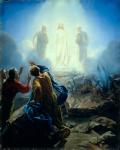
Jesus took with him Peter and James and his brother John and led them up a high mountain where they were alone. Jesus’ appearance was changed before them: his face shone like the sun and his clothes became bright as light. Just then Moses and Elijah appeared to them, talking with Jesus.
Peter spoke and said to Jesus, “Master, it is good that we are here. If you so wish, I will make three tents: one for you, one for Moses, and one for Elijah.”
Peter was still speaking when a bright cloud covered them in its shadow, and a voice from the cloud said, “This is my Son, the Beloved, my Chosen One. Listen to him.”
On hearing the voice, the disciples fell to the ground, full of fear. But Jesus came, touched them and said, “Stand up, do not be afraid.” When they raised their eyes, they no longer saw anyone except Jesus. And as they came down the mountain, Jesus commanded them not to tell anyone what they had just seen, until the Son of Man be raised from the dead.
Sunday
►1st Reading: Gen 12:1–4a
Yahweh said to Abram, “Leave your country, your family and your father’s house, for the land I will show you. I will make you a great nation. I will bless you and make your name great, and you will be a blessing. I will bless those who bless you, and whoever curses you, I will curse, and in you all peoples of the earth will be blessed.”
So Abram went as Yahweh had told him, and Lot went with him.
Abram was seventy-five years old when he left Haran.
►Ps 33:4–5, 18–19, 20, 22
Lord, let your mercy be on us, as we place our trust in you.
►2nd Reading: 2 Tim 1:8b–10
Dear brothers and sisters, do your share in laboring for the Gospel with the strength of God. He saved us and called us—a calling which proceeds from his holiness. This did not depend on our merits, but on his generosity and his own initiative. This calling given to us from all time in Christ Jesus has just been manifested with the glorious appearance of Christ Jesus, our Lord, who destroyed death and brought life and immortality to light in his Gospel.
►Gospel: Mt 17:1–9
Jesus took with him Peter and James and his brother John and led them up a high mountain where they were alone. Jesus’ appearance was changed before them: his face shone like the sun and his clothes became bright as light. Just then Moses and Elijah appeared to them, talking with Jesus.
Peter spoke and said to Jesus, “Master, it is good that we are here. If you so wish, I will make three tents: one for you, one for Moses, and one for Elijah.”
Peter was still speaking when a bright cloud covered them in its shadow, and a voice from the cloud said, “This is my Son, the Beloved, my Chosen One. Listen to him.”
On hearing the voice, the disciples fell to the ground, full of fear. But Jesus came, touched them and said, “Stand up, do not be afraid.” When they raised their eyes, they no longer saw anyone except Jesus. And as they came down the mountain, Jesus commanded them not to tell anyone what they had just seen, until the Son of Man be raised from the dead.
Tuesday, March 8, 2011
First Sunday of Lent
March 13
Sunday
►1st Reading: Gen 2:7-9; 3:1-7
Then Yahweh God formed Man, dust drawn from the clay, and breathed into his nostrils a breath of life and Man became alive with breath. God planted a garden in Eden in the east and there he placed Man whom he had created. Yahweh God caused to grow from the ground every kind of tree that is pleasing to see and good to eat, also the tree of Life in the middle of the garden and the tree of the Knowledge of Good and Evil.
Now the serpent was the most crafty of all the wild creatures that Yahweh God had made. He said to the woman, “Did God really say: You must not eat from any tree in the garden?” The woman said to the serpent, “We may eat the fruit of the trees in the garden, but of the fruit of the tree that is in the middle of the garden God said: You must not eat, and you must not touch it or you will die.” The serpent said to the woman, “You will not die, but God knows that the day you eat it, your eyes will be opened and you will be like gods, knowing good and evil.”
The woman saw that the fruit was good to eat, and pleasant to the eyes, and ideal for gaining knowledge. She took its fruit and ate it and gave some to her husband who was with her. He ate it. Then their eyes were opened and both of them knew they were naked. So they sewed leaves of a fig tree together and made themselves loincloths.
►Ps 51:3–4, 5–6, 12–13, 17
Be merciful, O Lord, for we have sinned.
►2nd Reading: Rom 5:12-19 (or Rom 5:12, 17–19)
Brothers and sisters: Therefore, sin entered the world through one man and through sin, death, and later on death spread to all humankind, because all sinned. As long as there was no law, they could not speak of disobedience, but sin was already in the world. This is why from Adam to Moses death reigned among them, although their sin was not disobedience as in Adam’s case – this was not the true Adam, but foretold the other who was to come.
Such has been the fall, but God’s gift goes far beyond. All died because of the fault of one man, but how much more does the grace of God spread when the gift he granted reaches all, from this unique man Jesus Christ. Again, there is no comparison between the gift and the offense of one man. The disobedience that brought condemnation was of one sinner, whereas the grace of God brings forgiveness to a world of sinners. If death reigned through the disobedience of one and only one person, how much more will there be a reign of life for those who receive the grace and the gift of true righteousness through the one person, Jesus Christ.
Just as one transgression brought sentence of death to all, so, too, one man’s good act has brought justification and light to all; and as the disobedience of only one made all sinners, so the obedience of one person allowed all to be made just and holy.
►Gospel: Mt 4:1-11
At that time, the Spirit led Jesus into the desert that he be put to the test by the devil. After spending forty days and nights without food, Jesus was hungry.
Then the devil came to him and said, “If you are the Son of God, order these stones to turn into bread.” But Jesus answered, “Scripture says: one does not live on bread alone, but on every word that comes from the mouth of God.”
Then the devil took Jesus to the holy city, set him on the highest wall of the temple, and said to him, “If you are the Son of God, throw yourself down, for scripture says, God has given orders to his angels about you. Their hands will hold you up lest you hurt your foot against a stone.” Jesus answered, “But scripture also says: You shall not put to the test the Lord your God.”
Then the devil took Jesus to a very high mountain and showed him all the nations of the world in all their greatness and splendor. And he said, “All this I will give you, if you kneel and worship me.” Then Jesus answered, “Be off, Satan! Scripture says: worship the Lord your God and serve him alone.”
Then the devil left him, and angels came to serve him.
Sunday
►1st Reading: Gen 2:7-9; 3:1-7
Then Yahweh God formed Man, dust drawn from the clay, and breathed into his nostrils a breath of life and Man became alive with breath. God planted a garden in Eden in the east and there he placed Man whom he had created. Yahweh God caused to grow from the ground every kind of tree that is pleasing to see and good to eat, also the tree of Life in the middle of the garden and the tree of the Knowledge of Good and Evil.
Now the serpent was the most crafty of all the wild creatures that Yahweh God had made. He said to the woman, “Did God really say: You must not eat from any tree in the garden?” The woman said to the serpent, “We may eat the fruit of the trees in the garden, but of the fruit of the tree that is in the middle of the garden God said: You must not eat, and you must not touch it or you will die.” The serpent said to the woman, “You will not die, but God knows that the day you eat it, your eyes will be opened and you will be like gods, knowing good and evil.”
The woman saw that the fruit was good to eat, and pleasant to the eyes, and ideal for gaining knowledge. She took its fruit and ate it and gave some to her husband who was with her. He ate it. Then their eyes were opened and both of them knew they were naked. So they sewed leaves of a fig tree together and made themselves loincloths.
►Ps 51:3–4, 5–6, 12–13, 17
Be merciful, O Lord, for we have sinned.
►2nd Reading: Rom 5:12-19 (or Rom 5:12, 17–19)
Brothers and sisters: Therefore, sin entered the world through one man and through sin, death, and later on death spread to all humankind, because all sinned. As long as there was no law, they could not speak of disobedience, but sin was already in the world. This is why from Adam to Moses death reigned among them, although their sin was not disobedience as in Adam’s case – this was not the true Adam, but foretold the other who was to come.
Such has been the fall, but God’s gift goes far beyond. All died because of the fault of one man, but how much more does the grace of God spread when the gift he granted reaches all, from this unique man Jesus Christ. Again, there is no comparison between the gift and the offense of one man. The disobedience that brought condemnation was of one sinner, whereas the grace of God brings forgiveness to a world of sinners. If death reigned through the disobedience of one and only one person, how much more will there be a reign of life for those who receive the grace and the gift of true righteousness through the one person, Jesus Christ.
Just as one transgression brought sentence of death to all, so, too, one man’s good act has brought justification and light to all; and as the disobedience of only one made all sinners, so the obedience of one person allowed all to be made just and holy.
►Gospel: Mt 4:1-11
At that time, the Spirit led Jesus into the desert that he be put to the test by the devil. After spending forty days and nights without food, Jesus was hungry.
Then the devil came to him and said, “If you are the Son of God, order these stones to turn into bread.” But Jesus answered, “Scripture says: one does not live on bread alone, but on every word that comes from the mouth of God.”
Then the devil took Jesus to the holy city, set him on the highest wall of the temple, and said to him, “If you are the Son of God, throw yourself down, for scripture says, God has given orders to his angels about you. Their hands will hold you up lest you hurt your foot against a stone.” Jesus answered, “But scripture also says: You shall not put to the test the Lord your God.”
Then the devil took Jesus to a very high mountain and showed him all the nations of the world in all their greatness and splendor. And he said, “All this I will give you, if you kneel and worship me.” Then Jesus answered, “Be off, Satan! Scripture says: worship the Lord your God and serve him alone.”
Then the devil left him, and angels came to serve him.
Subscribe to:
Comments (Atom)